-
Poll Watch: United States Economic Confidence the Best in Four Years
 According to the latest Gallup Poll.
U.S. economic confidence improved sharply to -18 in the week ending March 11 from -25 the prior week — the highest since the week ending Feb. 13, 2011, when it was also -18. The -18 readings this year and last are the highest weekly levels Gallup has recorded since it started tracking confidence daily in January 2008.
Americans’ economic confidence had declined recently from -20 in the week ending Feb. 12 to -25 for the week ending March 4. This brief deterioration in confidence may have been, at least in part, a response to increasing gas prices at the pump. However, the government’s positive unemployment report out last Friday appears to have given economic confidence another boost, as seemed to be the case following January’s unemployment report.
Gallup Daily tracking reveals that Americans’ confidence in the economy increased Friday, Saturday, and Sunday after the government report came out.
Read the entire report over at Gallup.
I am feeling better economic conditions in California although unemployment is unreasonably high and the state of California has massive budget deficits. I would say economic conditions are fluid and with rising fuel prices, there are unknowns on the horizon.
If I were President Obama, I would be leery of improving conditions to help in his re-election effort. And, if I were a GOP challenger, I would not be confident that a deteriorating economy would propel you into office.
It is important to note that Americans’ confidence in the economy was similar last year around this time. However, Americans’ hope for improvement in the overall economy during the months that followed the momentary surge in confidence early last year did not materialize. In fact, by last summer, the economy appeared to be near another downturn as politicians in the nation’s capital did battle over raising the federal debt ceiling.
It appears economic confidence is at another possible turning point, with gas prices on a pace to reach record highs in the summer. Further, it is not clear if the government can continue to report more good jobs news given modest economic growth.
For now though, it appears that higher gas prices have not been enough to keep Americans’ economic confidence from matching its highest weekly level in four years. However, if job increases slow, gas prices may quickly be perceived as an even more important threat, not only to Americans’ economic confidence, but also to the overall economy in the months ahead.
-
U.S. Job Creation Declines in February – Hiring Down and Firing Up
 According to the latest Gallup Poll.
Job market conditions in the United States slid back slightly in February, as Gallup’s Job Creation Index fell to +14 from +16 in January. The February score matches those recorded from October through December 2011. However, the reading last month reflects an improvement of two percentage points compared with a year ago (+12 in February 2011).

Hiring Down, Firing UpThe February Job Creation Index of +14 is based on 32% of workers nationwide saying their employers are hiring workers and expanding the size of their workforce, and 18% saying their employers are letting workers go and reducing the size of their workforce. The percentage hiring is down from 33% in January, while the percentage letting go is up from 17%. Both February percentages now match the readings recorded each month in the fourth quarter of 2011.
The chart:
What does all mean?
The American economy is NOT dramatically improving on the jobs front. With gasoline prices haven risen and rising and job creation prospects flat around the country in almost all regions – see map at the top), the Obama Administration will have a hard time making a case for success of their economic policies.
Declining consumer confidence is also generally unfavorable for the economy.
Gallup’s March numbers are looking a little better, but stay tuned since it is early in the month.
There will be no carping from the White House on these numbers, in advance of the government’s release of their numbers on Friday.
-
Poll Watch: 22 Per Cent of Americans Satisfied With the Way Things Are Going
 According to the latest Gallup Poll.
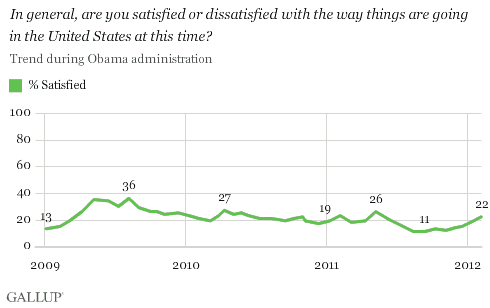
The majority of Americans remain dissatisfied with the way things are going in the U.S., but the percentage who are satisfied continues to increase. Satisfaction, now at 22%, is higher than at any point since last spring.
Thirteen percent of Americans were satisfied with the state of the nation when President Barack Obama took office in January 2009. This percentage increased to as high as 36% in August 2009 before falling to the lower levels seen since then. As the economy struggled to recover during the past two years, and as the federal government had trouble reaching agreement on the major issues facing the country, satisfaction dropped, to as low as 11% last August and September.
The current results, based on a Feb. 2-5 Gallup poll, find satisfaction up significantly from December after slight increases each of the past two months. The increases are likely due to Americans’ greater optimism about the U.S. economy. The poll included three days of interviewing after the government released its positive employment report on Feb. 3.
22 per cent is nothing to write home about.
Let’s hope it continues to improve.
What are the implications?
Better news for President Obama’s re-election, but the numbers are still low historically. And, as Carly Fiorina just pointed out on Fox News and who will be delivering a speech at CPAC tomorrow, small business growth remains slow, if not stagnant, due to Obama Administration policies – namely taxation and regulation.
-
Poll Watch: Americans Ability to Afford Food Falls to Near Three Year Low
According to the latest Gallup Poll.
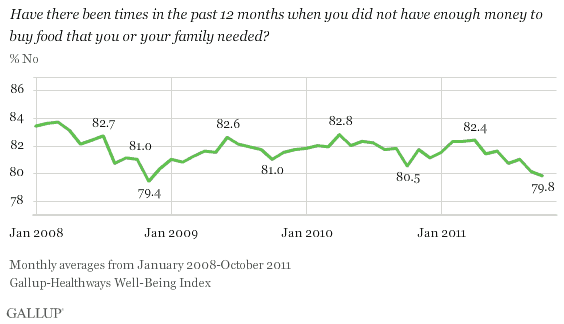
The percentage of Americans reporting that they had enough money to buy the food they or their families needed continued to decline in October, nearing the record low seen in November 2008. The percentage who did not lack money for food in 2011 fell to 79.8% from 80.1% in September, continuing a decline that began in April.
This is only the second time since Gallup and Healthways began tracking this measure as part of the Gallup-Healthways Well-Being Index in January 2008 that less than 80% of Americans reported that they had enough money to buy food throughout the past year. The record low was in November 2008, at the start of the economic crisis, when 79.4% reported that they had enough money to buy food for themselves or their families.
This measure — which asks if one had enough money to buy food in the past 12 months — has decreased to its lowest level of the calendar year each October since 2009. The reason for this pattern is unclear and does not appear to be related to world food prices. In 2008, fewer Americans reported that they had enough money to buy food in August and November than in October, likely affected by high gas prices in the former case and the onset of the economic crisis in the latter. Still, this October finds fewer Americans saying that they had enough money to buy food over the past year than in each October for the past three years.
Americans’ Access to Basic Needs Falls to New Record Low
Americans’ access to basic needs is now at the lowest level recorded since Gallup and Healthways began tracking it in January 2008. The Basic Access Index — which comprises 13 measures, including Americans’ ability to afford food, housing, and healthcare — declined to a record-low score of 81.2 in October. This means Americans’ access to basic needs, though still high in an absolute sense, is now worse than it was throughout the economic crisis and recession, including the prior record lows recorded in February and March 2009.
I wonder when some of these poor economic conditions in America will be referred to Obama creaations or the Occupy encampments as Obamavlles?
With the left-wing media, probably never. But, American voters understand and will take action accordingly.
-
American Unemployment Rate Steady at 9.1% Beating Tepid Expectations
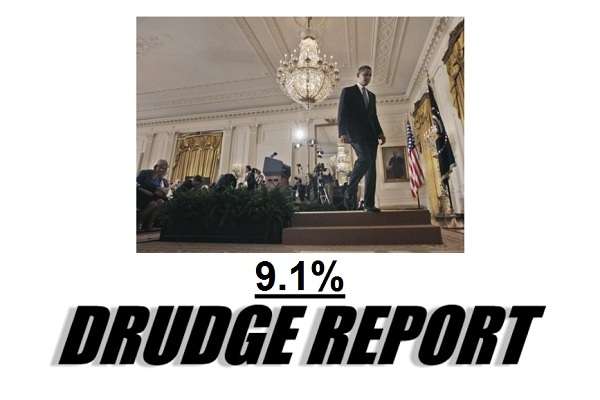
Not the greatest, but 103,000 new jobs were added, albeit almost half were added because Verizon employees came off a strike.
The U.S. jobs picture beat tepid expectations, with the economy creating a significantly better than expected 103,000 new jobs in September that nonetheless was not enough to cut the unemployment rate from 9.1 percent.Economists had been looking for 60,000 total new nonfarm jobs, a month after the shock that the U.S. had created a net of zero new jobs.
That August number, though, was revised upward in the latest report, to show the economy creating 57,000 jobs for the month.
“Today’s data show the persistence of merely moderate employment gains,” Citigroup economist Steven Wieting said in a note. “Employment can be a poor guide to more than the immediate future, but the data confirm our view that early August economic reports exaggerated U.S. weakness.
Getting the jobs market rolling again is seen as one of the two central spokes — the other being housing — in preventing the US economy from entering another recession.
Friday’s numbers offered mild consolation to those hoping that the US can at least plod along if not move into expansion mode.
Striking Verizon workers back on the job fed much of the gains as 45,000 of the telecom giant’s employees came off the picket lines and the unemployment rolls.
Average hourly earnings in September rose slightly to $23.12.
“In the big picture, today’s reading soothes recessionary fears,” said Andrew Wilkinson, chief economic strategist at Miller Tabak in New York.
The enthusiasm, albeit muted, was not universally shared.
“The September performance is more of a dead cat bounce than real progress,” Peter Morici, economist at the University of Maryland, said in a snap analysis. “Jobs creation will remain inadequate to keep unemployment from falling in the months ahead, especially considering the mass layoffs recently announced in banking and pharmaceuticals that will be effected in the months ahead.”
Long-term unemployment remains a problem, as the average duration of joblessness ticked up to a new record of 40.5 weeks. The number of those out of work for more than 20 weeks rose 208,000 to 6.24 million.
The manufacturing sector shed 13,000 jobs, posting a drop for the second month in a row. But the household survey, which is a more methodical count that doesn’t utilize estimations in the way the larger survey does, showed a net job creation of 137,000.
The level of unemployed people remained unchanged, though, at 14 million.
The jobs market is stagnant as is the rest of the economy. There will probably not be any movement until the direction of federal government initiatives are made clear and the Presidential campaign season offers some clarity.
-
United States Becomes Handout Nation With Half Living in a Household Receiving Government Benefits

Nearly half of all Americans live in households that received some government benefit in the first quarter of 2010, according to census data.
Families were more dependent on government programs than ever last year.Nearly half, 48.5%, of the population lived in a household that received some type of government benefit in the first quarter of 2010, according to Census data. Those numbers have risen since the middle of the recession when 44.4% lived households receiving benefits in the third quarter of 2008.
The share of people relying on government benefits has reached a historic high, in large part from the deep recession and meager recovery, but also because of the expansion of government programs over the years. (See a timeline on the history of government benefits programs here.)
Means-tested programs, designed to help the needy, accounted for the largest share of recipients last year. Some 34.2% of Americans lived in a household that received benefits such as food stamps, subsidized housing, cash welfare or Medicaid (the federal-state health care program for the poor).
Another 14.5% lived in homes where someone was on Medicare (the health care program for the elderly). Nearly 16% lived in households receiving Social Security.
High unemployment and increased reliance on government programs has also shrunk the nation’s share of taxpayers. Some 46.4% of households will pay no federal income tax this year, according to the nonpartisan Tax Policy Center. That’s up from 39.9% in 2007, the year the recession began.
Most of those households will still be hit by payroll taxes. Just 18.1% of households pay neither payroll nor federal income taxes and they are predominantly the nation’s elderly and poorest families.
The tandem rise in government-benefits recipients and fall in taxpayers has been cause for alarm among some policymakers and presidential hopefuls.
The American economy is facing a collapse unless something is done by the federal government to stimulate economic growth. And, America is not going to achieve this by taxing the rich.
President Obama and Senate Democrats have better get serious about the economy or get the hell out of the way and let the GOP House do it.

-
Poll Watch: Americans By a Small Majority Blame Obama for the Economy – But Still Blame Bush More
 According to the latest Gallup Poll.
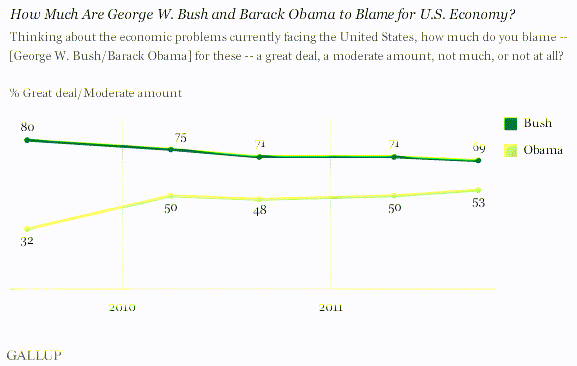
A slight majority of Americans for the first time blame President Obama either a great deal (24%) or a moderate amount (29%) for the nation’s economic problems. However, Americans continue to blame former President George W. Bush more. Nearly 7 in 10 blame Bush a great deal (36%) or a moderate amount (33%).
Gallup found a substantially wider gap in public perceptions of how much responsibility Bush and Obama each bore for the economy when it first asked the question in July 2009, the sixth month of Obama’s presidency. That narrowed by March 2010, caused mainly by a jump in the percentage blaming Obama a great deal or moderate amount, and has since changed relatively little. However, the results from a new Sept. 15-18 USA Today/Gallup poll are the first showing a majority of Americans, 53%, assigning significant blame to Obama. Forty-seven percent still say he is “not much” (27%) or “not at all” (20%) to blame.
I think Americans realized that after the Bush Presidency they must give President Obama a chance and have given him a honeymoon of sorts. But, the bloom has come off the rose.
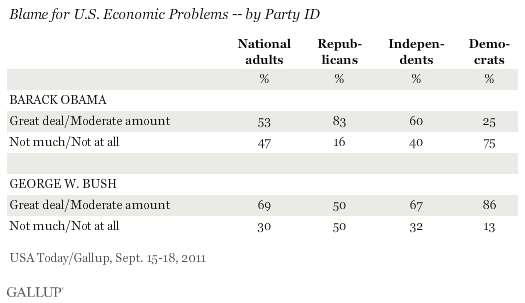
But, more Republicans are willing to blame Bush more than Democrats to blame Obama, so electorally, this does not help the President’s re-election prospects.
The chart:
 So, what does this all mean?
President Obama is now accruing blame for the poor economy. Since President Bush will not be on the ballot, he had better find either an economic solution or a better excuse than it is Bush’s fault (particularly with independent voters).
Former President Bush continues to take a harder hit than President Obama in public perceptions of who is responsible for the nation’s ongoing economic problems. However, that is largely because Republicans are more willing to blame Bush than Democrats are to blame Obama. Because most Republicans and Democrats are going to vote for their own party’s presidential candidate in 2012, this imbalance won’t help Obama much electorally.
More importantly, about 6 in 10 political independents believe both presidents bear considerable blame. That is not good news for Obama. In his re-election campaign, he will likely try to convince independents that although the economy hasn’t markedly improved on his watch, his policies prevented the bad economic situation he inherited from Bush from becoming even worse.
Other Gallup polling confirms that the economy is going to be a treacherous issue for Obama to navigate in the coming year. At 26%, his most recent approval rating on the economy, from August, is his lowest to date, and Americans’ economic confidence remains weakened compared with earlier this year, after the bruising debt ceiling debate over the summer. The public may not see Obama as culpable for the economy to the same degree as Bush, but that won’t be sufficient protection from voters’ wrath if the majority — including 60% of independents — nevertheless considers him highly responsible.
-
Poll Watch: Americans Favor Taxing the Rich and Obama’s Job Plan
 According to the latest Gallup Poll.
Americans generally favor raising taxes on higher-income Americans and eliminating tax deductions for some corporations as ways of paying for President Obama’s proposed jobs plan.
Slightly more than half of rank-and-file Republicans and Republican-leaning independents favor the idea of eliminating certain corporate tax deductions as a way to pay for a jobs creation bill. Forty-one percent of Republicans favor raising taxes on higher-income Americans. Democrats strongly favor both proposals for paying for the cost of the jobs bill.
Not really a surprise because nobody considers themselves rich. But, how can anyone possibly think this will lead to job creation?
Americans Favor Almost All Proposals in Obama’s Jobs Plan
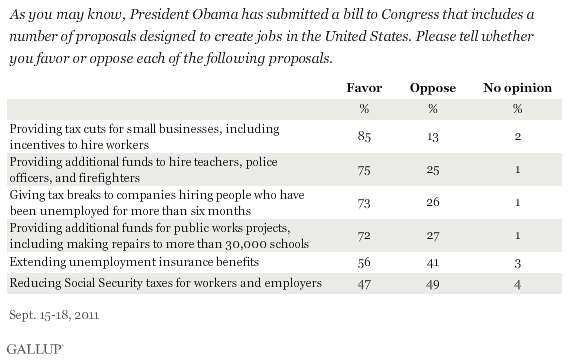
Americans agree with a number of the job-creation proposals included in Obama’s jobs plan — specifically including the ideas of providing tax cuts to small businesses; providing additional funds for hiring teachers, police officers, and firefighters; and giving tax breaks to corporations for hiring the long-term unemployed. Slightly less than half favor reducing Social Security taxes for workers and employers.
The chart:
 So, what does this all mean?
This is the second Gallup survey conducted in the last two weeks showing that the American public broadly supports Obama’s jobs plan. A majority of Americans interviewed this past weekend believe the plan would help at least a little to create jobs and improve the economy.
Many of the proposals embedded in the plan receive majority support, and Americans strongly endorse the idea of paying for the plan by raising taxes on higher-income individual taxpayers and by eliminating tax deductions for some corporations. While Republicans are considerably less positive about the potential efficacy of the plan than are Democrats, a majority of the former favor a number of Obama’s proposals, and also favor eliminating tax deductions for corporations to help fund the plan.
But, the real question is whether these proposals work? Will any jobs be created?
Popularity may win you votes, but not necessarily produce an improving economy.
-
Poll Watch: Unemployment Rate Improves in Mid-September to 8.8% But Underemployment Remains High
 According to the latest Gallup Poll.
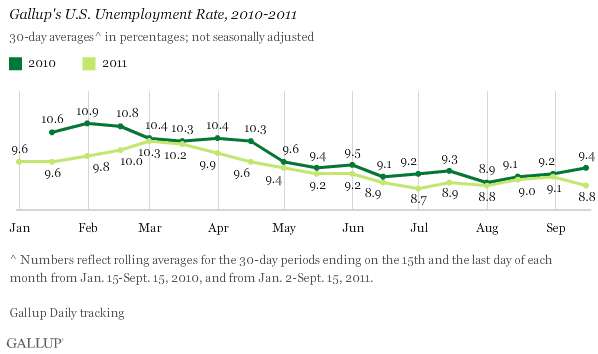
Unemployment, as measured by Gallup without seasonal adjustment, is 8.8% in mid-September — down from 9.1% at the end of August and the same as it was at the end of July. However, the apparent improvement in unemployment from August to mid-September may merely reflect normal seasonal hiring patterns and not be an indication that the employment situation is improving. On the other hand, current unemployment is considerably better than the 9.4% of a year ago.
But……
Underemployment remains stuck at 18.5% in Mid-September.
Underemployment, a measure that combines the percentage of workers who are unemployed with the percentage working part time but wanting full-time work, is 18.5% in mid-September — the same as the 18.5% at the end of August and the 18.6% of mid-September a year ago.
Number Forced to Take Part-time Work Increases
Offsetting the drop in the percentage of unemployed is an increase to 9.7% in the percentage of part-time workers who want full-time work in mid-September — up from 9.4% at the end of August and its highest level since mid-June. It is also up from 9.2% in mid-September last year. It is this increase, coupled with the downturn in unemployment, that yields the stability this month in the measure of overall underemployment.
The chart:
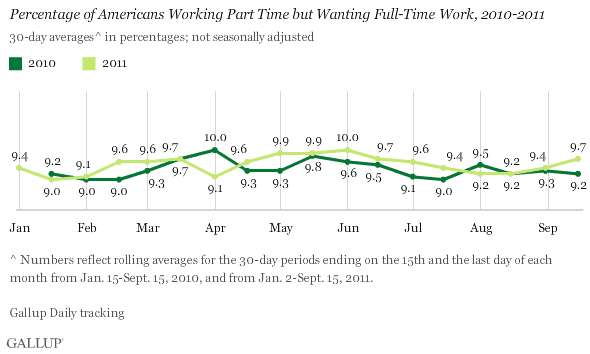
Gallup’s issues a caveat that the improving unemployment rate may not indicate that the employment situation is improving appreciably because of the difference in their polling methodology as compared to the government’s. Gallup maintains that the underemployment rate is a better indicator.
Nearly one in five Americans remain underemployed this year, as was the case a year ago, and the figures are worse for certain subgroups, including 28.9% underemployment for those 18 to 29, 23.1% for those who have not attended college, and 27.8% among blacks.
More Americans are now being forced to take part-time jobs when they really want full-time work. Focusing merely on unemployment instead of underemployment tends to ignore the hardship facing the millions of Americans forced to work part time. The long-term implications of this jobs situation — particularly among specific groups of Americans — for U.S. society as a whole may be more important than any of the major topics currently being debated nationally.
In other words, the employment situation is not improving appreciably.
-
Poll Watch: Three Years After Economic Crisis Little Sign of Amercian Relief
 According to the latest Gallup Poll.
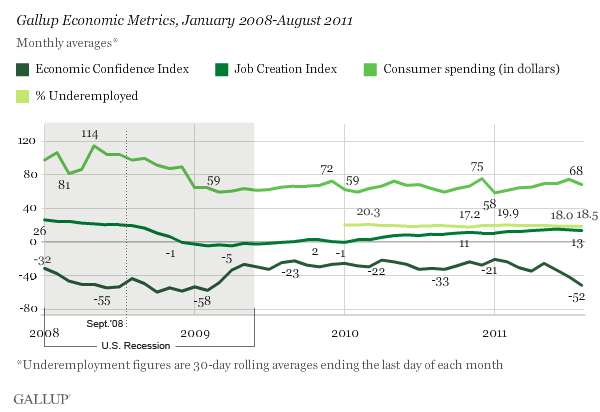
Three years after bankruptcy of Lehman Brothers jolted the U.S. economy into economic turmoil, job creation has rebounded from post-collapse lows, but economic confidence and consumer spending remain within the ranges seen in 2009. Gallup finds underemployment and unemployment essentially where they were a year ago.
Gallup has been tracking Americans’ economic confidence, consumer spending, and employee reports about hiring and firing at their workplaces since 2008, and employment since January 2010, as part of its Gallup Daily tracking program. The findings in this analysis are based on monthly averages, based on approximately 15,000 interviews per month.
Here is the summary of findings:
- Economic Confidence: Back at Recessionary Levels
- Job Creation: Improved From 2009-2010 Lows, but Far From Early 2008 Levels
- Underemployment and Employment: Stuck at Year-Ago Levels
- Consumer Spending: Nowhere Near 2008 Levels
So, what does it all mean?
President Obama and his Administration have not been successful in steering the economy towards economic recovery. Failure is a word that comes to mind and it is reflected in many polls showing Obama struggling in approval ratings.